
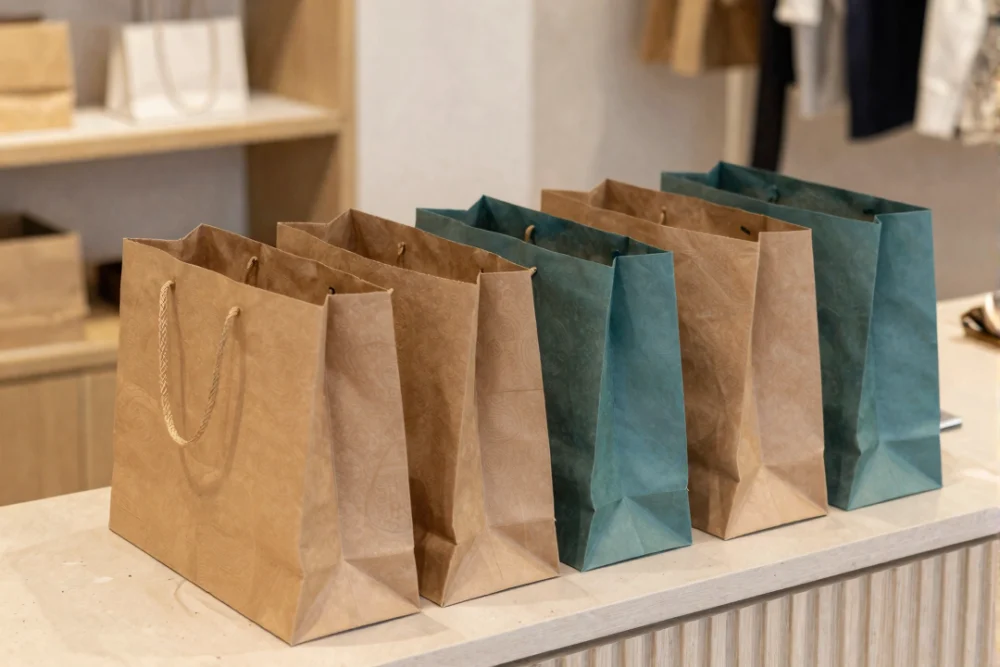
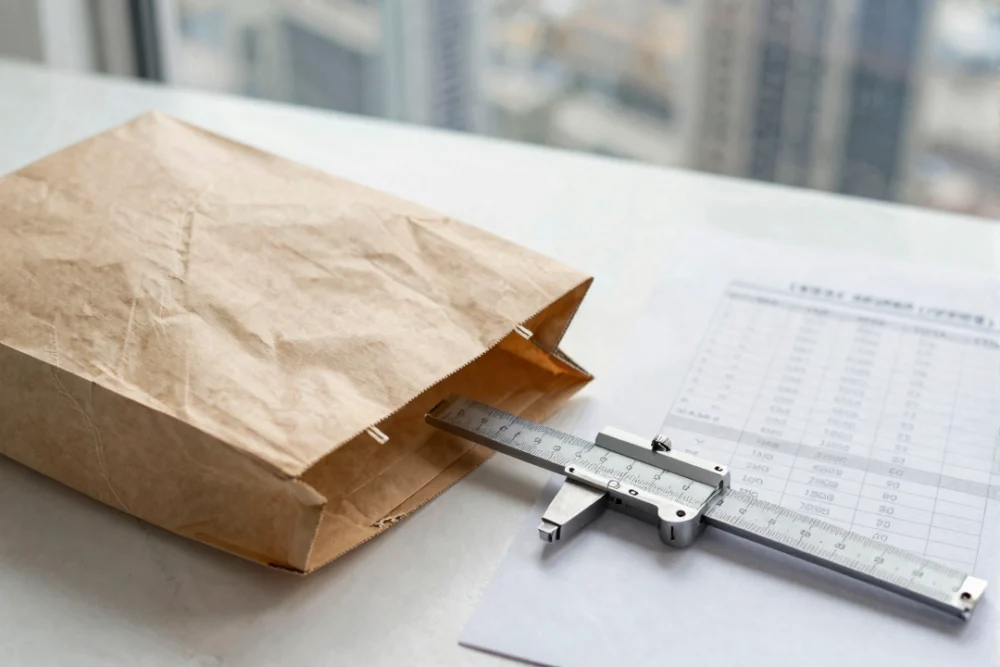
A micrometer and checklist verify the 58 micrometer minimum for Dubai checkout bags.
Choose paper bag printing in Dubai with confidence
Paper bag printing dubai choices get easier when you start with local bag rules, then match paper strength, printing method, and delivery timing to your retail or event plan.
Dubai teams need bags that look premium, carry weight safely, and meet local requirements. This guide gives a clear decision path with checklists, practical tests, and vendor-ready specs you can use right away.
Use it to align branding with compliance, avoid production errors, and deliver on time for retail floors or event venues.
Key Takeaways
- Confirm the 57 micrometer rule before you approve any checkout bag material.
- Match paper weight and reinforcement to the product load, not the design mood.
- Pick a print method that fits your run size and timeline, then prove color accuracy.
- Use a vendor brief that locks specs, proofs, and lead times before production.
- Plan delivery like a project, not a shipment, especially for event venues.
Understand Dubai bag rules before you print
What it is: Dubai regulates single-use bags by thickness, and this includes paper and biodegradable bags at checkout.
Why it matters: If a bag falls under the thickness limit, it can be treated as a single-use bag and create compliance risk. That risk also creates operational waste, because reprints and last-minute replacements cost time.
How to do it: Confirm thickness in micrometers during quoting. Include the minimum thickness in your purchase order and proof approval. Treat it as a non-negotiable spec.
What to avoid: Do not assume paper equals compliant. The rule targets thickness, not material.
- 57 micrometers or less is banned for single-use bags at checkout, including paper and biodegradable bags.
- 58 micrometers or more is allowed for checkout bags.
- June 1, 2024 is the enforcement date for the expanded single-use bag ban.
What good looks like: Your supplier confirms the exact thickness, you keep a spec sheet in your files, and the thickness appears in the purchase order.
Common mistake and fix: Teams approve “standard paper bags” without a thickness check. Fix it by asking for micrometer thickness and requiring it in the quote.
Confirm what counts as single-use in Dubai
What it is: Dubai defines single-use bags by thickness. This includes plastic, paper, and plant-based materials.
Why it matters: A bag can feel sturdy but still fall under the threshold and be treated as single-use.
How to do it: Use the micrometer threshold as a pass or fail acceptance test. Ask for a material spec or identification tag if the vendor provides one.
What to avoid: Avoid vague terms like “thin paper” or “lightweight.” Those create compliance risk.
What good looks like: A vendor can show thickness in micrometers and confirm compliance in writing.
Choose the right paper material and finish
What it is: Material and finish define strength, sustainability, and how your brand is perceived.
Why it matters: A bag that looks premium but fails under load can harm trust. A bag that is too heavy or overly coated can reduce recyclability and raise cost.
How to do it: Pick a material that matches load, feel, and sustainability goals. Then choose a finish that supports printing quality without undermining recyclability.
What to avoid: Do not choose a finish only for appearance. Always check how it affects recyclability and durability.
- Kraft paper offers strength and a natural, eco-forward look.
- Recycled paper supports sustainability and works for lighter items.
- FSC-certified paper supports responsible sourcing claims.
- Seed paper is a strong fit for special campaigns and giveaways.
- Coated or laminated papers enhance print quality but can reduce recyclability.
- Water-based coatings improve resistance while supporting sustainability goals.
- Uncoated, food-grade kraft supports food and beverage use.
What good looks like: The material choice ties directly to your product weight and brand story. The finish supports the artwork without blocking recyclability.
Common mistake and fix: Teams choose a coated finish to boost shine, then discover lower recyclability. Fix it by confirming the impact of coatings with the supplier and using water-based options where possible.
Match GSM to product weight
What it is: GSM is the weight of paper and a practical indicator of strength.
Why it matters: GSM that is too low leads to torn corners, broken handles, and poor customer experience.
How to do it: Use GSM ranges as a starting point and verify with a load test using the real product.
What to avoid: Avoid choosing GSM by design preference alone.
- 100 GSM works for light items and daily use.
- 120 GSM or higher supports heavier use cases.
- 200 to 300 GSM is recommended for heavy products, especially with board inserts and reinforced handles.
What good looks like: The bag carries the real product without warping, tearing, or handle stress after a short walk.
Common mistake and fix: Teams skip a load test and discover failures after distribution. Fix it by testing real items and adjusting GSM or reinforcements.
Pick the printing method that fits your run size
What it is: Printing methods vary by speed, cost per unit, and print detail.
Why it matters: A method that is perfect for a large run can be wasteful for a small run, and vice versa. It also affects how sharp the logo appears.
How to do it: Match run size and deadline to the method. Digital is flexible for short runs, offset is reliable for large volumes, flexographic supports high-volume with simple designs, and screen printing is best for bold, simple visuals.
What to avoid: Do not use a large-run method for a quick, small batch if time is tight.
- Digital printing supports fast changes and short runs.
- Offset printing provides sharp, consistent color for large runs.
- Flexographic printing is cost-effective for high-volume production.
- Screen printing works well for bold designs with few colors.
- Hot stamping adds premium metallic accents for luxury positioning.
What good looks like: The selected method matches your order size, timeline, and design complexity without forcing extra waste or cost.
Common mistake and fix: Teams choose offset for a small, last-minute run and miss the deadline. Fix it by using digital for fast small batches and reserving offset for bulk orders.
Protect brand color and clarity
What it is: Color and clarity depend on correct color systems, file resolution, and proofing.
Why it matters: A color shift or blurry logo weakens brand identity, especially in retail where bags become part of the customer experience.
How to do it: Use PMS for color accuracy, supply high-resolution artwork, and request a proof before bulk production.
What to avoid: Avoid RGB-only files and skipping proofs.
- PMS improves color consistency and brand accuracy.
- 300 DPI artwork reduces pixelation and blur.
- Proofs catch color, alignment, and edge issues before the full run.
What good looks like: The proof matches brand colors and logo clarity in real lighting.
Common mistake and fix: Teams approve a digital mockup without a proof. Fix it by requiring a printed proof or sample swatch.
Prevent the most common print failures
What it is: Paper bag printing can fail in predictable ways that are easy to prevent.
Why it matters: Each failure damages brand perception and forces rework or replacement.
How to do it: Use a failure-prevention checklist before approving production.
What to avoid: Avoid rushing from design to production without quality checks.
- White edges on colored bags occur when printing on white paper; use pre-dyed colored paper.
- Corner tearing comes from weak fibers and sharp folds; add lamination where needed.
- Mismatched handles disrupt visual cohesion; use custom-dyed handles to match bag color.
- Low GSM or weak handles fail under load; increase GSM and add reinforcements.
- Strong chemical odor signals non-food-grade inks; use water- or soy-based food-grade inks for food use.
- RGB to CMYK conversion causes color shift; use correct print color modes.
- Incorrect bleed creates white borders; set bleed correctly before print.
What good looks like: The final bag has consistent color, clean edges, strong corners, and handle stability.
Common mistake and fix: Teams approve a low-resolution file and get blurry print. Fix it by enforcing a 300 DPI minimum and a file review step.
Plan MOQ, cost efficiency, and timing
What it is: MOQ and lead time planning ensures you order the right amount and receive it when you need it.
Why it matters: Too few bags mean stockouts. Too many bags increase storage and waste. Missed event delivery can derail an entire activation.
How to do it: Use a planning flow: estimate usage, choose a method by run size, confirm MOQ, and lock a timeline with the supplier.
What to avoid: Avoid choosing a method that forces a larger MOQ than you can use.
- Eco-friendly bag orders can start at 100 pieces for low MOQ needs.
- Custom eco bag lead time is often 5 to 10 working days.
- Digital printing suits small runs; offset or flexo lowers per-unit cost for large runs.
- Digital works well around 100 bags; offset or flexo becomes cost-effective around 10,000 bags.
What good looks like: You have a clear quantity plan per store or event, plus a buffer for peak days.
Common mistake and fix: Teams place large orders to chase lower unit cost without a usage plan. Fix it by projecting usage and choosing the minimum viable run size.
Deploy for retail and events in Dubai
What it is: Deployment is the handoff from production to real-world use, including delivery to venues and integration with other collateral.
Why it matters: In events, packaging is photographed and shared. In retail, bags may travel in public and become mobile brand touchpoints.
How to do it: Align bag production with the event collateral plan and confirm delivery details with venues.
What to avoid: Avoid shipping bags without confirming venue access and storage requirements.
- Event collateral includes brochures, signage, badges, folders, and giveaways that should match bag design.
- Delivery to major venues like DWTC, Dubai Expo City, and Madinat Jumeirah requires planned logistics.
- Premium finishes like embossing or foiling support high-end event positioning.
What good looks like: Bags arrive before setup, match the event theme, and are staged with other collateral.
Common mistake and fix: Teams treat bags as a late add-on. Fix it by locking bag specs at the same time you finalize event signage and folders.
Use this vendor brief checklist
What it is: A vendor-ready brief that reduces back-and-forth and locks requirements before production.
Why it matters: Clear specs prevent errors and make delivery schedules predictable.
How to do it: Fill out each field, attach artwork, and request proofs before approving the full run.
What to avoid: Avoid giving only a logo and expecting the supplier to decide specs.
| Field | What to specify | Why it matters |
|---|---|---|
| Bag use case | Retail checkout, event giveaway, food and beverage, or luxury gifting | Guides material and reinforcement |
| Thickness | 58 micrometers or more for checkout bags | Aligns with Dubai single-use bag rules |
| GSM | 100 GSM for light items, 120 GSM or higher for heavy use, 200 to 300 GSM for heavy products | Prevents tearing and handle failure |
| Material | Kraft, recycled, FSC-certified, seed paper, or uncoated food-grade kraft | Aligns with sustainability and brand tone |
| Finish | Uncoated, water-based coating, embossing, or foiling | Balances appearance and recyclability |
| Handles | Handle type and color match | Improves comfort and brand cohesion |
| Print method | Digital, offset, flexographic, or screen | Matches run size and detail needs |
| Color system | PMS references and CMYK files | Prevents color mismatch |
| Artwork quality | 300 DPI files and correct bleed | Prevents blur and white edges |
| Proofing | Printed proof or material swatch | Confirms quality before bulk |
| Ink | Water- or soy-based food-grade inks for food use | Prevents odor and safety issues |
| MOQ and lead time | Low MOQ from 100 pieces and lead time of 5 to 10 working days | Aligns production with schedules |
What good looks like: The brief reads like a spec sheet, not a suggestion. It includes acceptance criteria, proofs, and a clear timeline.
Common mistake and fix: Teams skip proofing to save time, then reprint due to quality issues. Fix it by locking proofing into the timeline.
Combine bags with boxes when it improves the experience
What it is: Bags and boxes can work as a set to protect products and build a premium unboxing moment.
Why it matters: For luxury retail and events, a coordinated set increases perceived value and reduces damage risk.
How to do it: Match material feel, color system, and finish across the set, then test it with real products.
What to avoid: Avoid mixing premium boxes with low-quality bags.
- Use custom packaging printing dubai to align bags and boxes under one visual system.
- Use custom boxes dubai for heavier or fragile products that need protection.
- Use gift box printing dubai for premium gifting moments where presentation matters.
- Use printed boxes dubai when unboxing is part of the brand promise.
What good looks like: The box protects the product, and the bag carries the brand story in public.
Common mistake and fix: Teams order boxes and bags from different vendors with unmatched colors. Fix it by using the same PMS references and proofing both items together.
Make a practical supplier decision
What it is: The final step before production is a clear supplier choice based on compliance, quality control, and timing.
Why it matters: The supplier’s process determines your success more than the design alone.
How to do it: Compare suppliers on proofing, material range, print methods, and delivery capacity. Confirm thickness and lead time in writing. If you are finding suppliers near me in Dubai, UAE, request a sample kit to verify material and print quality.
What to avoid: Avoid choosing a supplier based only on the lowest price.
Providers like GFX Printer can help teams align materials, printing methods, and delivery schedules for retail and event needs.
These internal resources can reduce confusion and speed up decision-making:
- paper guide
- delivery and turnaround
- packaging
- paper bags
- shopping bags printing
- custom packaging printing dubai guide
- digital printing vs. traditional
- what is offset printing
- how to set up bleed
References
- Executive Council Resolution No. (124) of 2023 Regulating the Use of Single-use Products in the Emirate of Dubai ? Dubai Government ? Executive Council Resolution No. (124) of 2023 Regulating the Use of Single-use Products in the Emirate of Dubai
- Biodegradable, paper and plant-based: Dubai clarifies details on June 1 bag ban ? The National ? 2024-03-29 ? Biodegradable, paper and plant-based: Dubai clarifies details on June 1 bag ban
- Dubai’s ban on all single-use bags from June 1: Know the fines and rules ? Gulf News ? 2024-05-25 ? Dubai’s ban on all single-use bags from June 1: Know the fines and rules
- United Arab Emirates: Regulations on single-use products – Environmental sustainability in Dubai ? Global Compliance News ? 2024-03-18 ? United Arab Emirates: Regulations on single-use products – Environmental sustainability in Dubai
- Eco Friendly Paper Bags in Dubai | Sustainable Choices for You ? veesham ? 2025-06-24 ? Eco Friendly Paper Bags in Dubai | Sustainable Choices for You
- #1 Printing Press in Dubai – Veesham Printing Press ? veesham ? 2025-09-11 ? #1 Printing Press in Dubai – Veesham Printing Press
- Digital Printing vs. Offset Printing: How to Choose the Right Option ? Dubai Printing Press ? 2024-04-02 ? Digital Printing vs. Offset Printing: How to Choose the Right Option
- Top Printing Techniques For Paper Packaging Bags: What You Need To Know ? Custom Packaging Bag Supplier ? 2025-01-26 ? Top Printing Techniques For Paper Packaging Bags: What You Need To Know
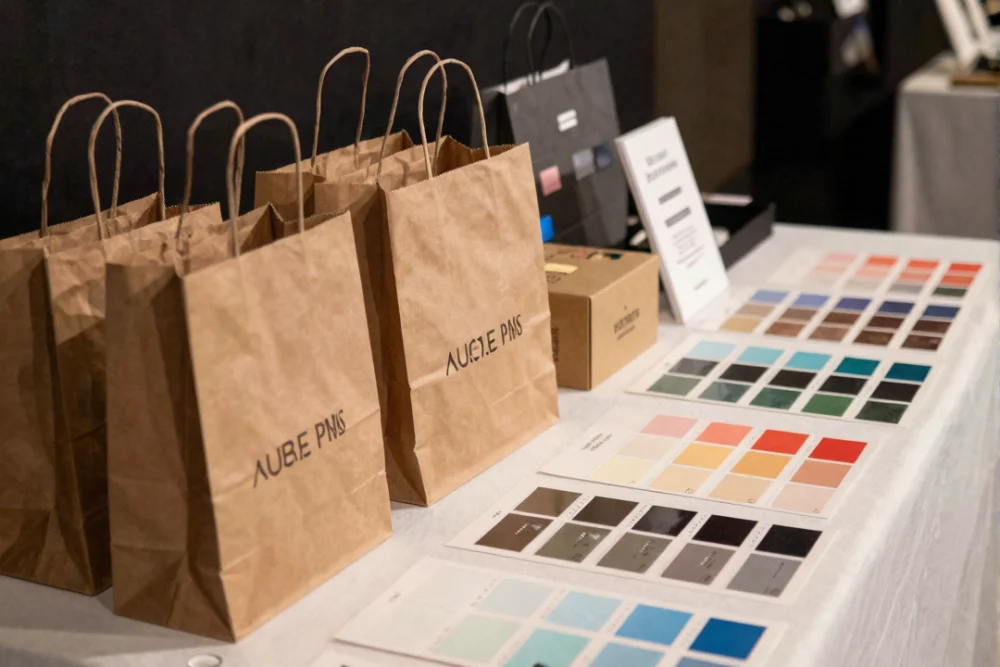
Coordinated bags, boxes, and swatches illustrate how Dubai events align packaging with brand colors and finishes.
Frequently Asked Questions
Are paper bags banned in Dubai?
Dubai bans single-use bags that are 57 micrometers or thinner, and this includes paper and biodegradable bags. The rule took effect on June 1, 2024. Bags that are 58 micrometers or thicker are allowed for checkout use. Fines apply for non-compliance, and repeat violations face higher penalties.
What bag thickness is allowed for checkout bags in Dubai?
Dubai allows checkout bags that are 58 micrometers or thicker. Bags 57 micrometers or thinner are treated as single-use and are not allowed. This threshold applies across materials, including paper and plant-based bags. If you are sourcing for paper bag printing dubai projects, confirm thickness in micrometers with the supplier before approval.
Which paper materials are commonly used for retail and event bags in Dubai?
Common options include kraft paper for strength and a natural look, recycled paper for lighter items, FSC-certified paper for ethical sourcing, and seed paper for special campaigns. Uncoated and food-grade kraft works for food and beverage use. Water-based coatings can add resistance while keeping the bag aligned with sustainability goals.
How do I choose the right printing method for paper bags?
Digital printing works well for short runs and fast changes. Offset printing gives sharp, consistent color for larger runs. Flexographic printing suits high-volume orders with simpler designs. Screen printing fits bold, simple graphics. Hot stamping adds premium metallic accents. Choose the method based on run size, timeline, and design complexity.
What GSM should I use for heavy items in a paper bag?
For light items, 100 GSM is commonly used. For heavier items, 120 GSM or higher is recommended. Some suppliers advise 200 to 300 GSM for heavy products, especially when combined with board inserts and reinforced handles. Always test the bag with the real product load.
How long does it take to get custom paper bags in Dubai?
Custom eco-friendly paper bags in Dubai typically take 5 to 10 working days, depending on the design and order volume. Low minimum orders can start at 100 pieces for some bag types. Confirm timelines early if you are planning for a retail launch or event delivery.


